 how-to
How to Choose Professional Transportation for Guests
Last Updated: November 6, 2026
Quick Summary
Choose professional guest transportation by first estimating ridership, not by picking a vehicle: start with your full guest list and subtract local drivers, walkable hotel stays, and confirmed self-drivers. Then match the rider count to a vehicle type and compare quotes on total estimated cost, not hourly rate.
- Sprinter vans suit 10-14 riders, minibuses 20-30, motor coaches 40-56, and party buses 14-30.
- Ask on the RSVP whether guests need a shuttle and track responses in a spreadsheet.
- One central hotel pickup point beats three scattered stops for faster loading.
- Compare quotes on total estimated cost, since minimum hours, gratuity, and surcharges inflate invoices.
- Add 15 minutes to each arrival window so one late guest does not collapse the schedule.
Table of Contents
- Start With a Ridership Estimate, Not a Vehicle
- Transportation Options for Large Groups, Compared
- How to Ask Guests If They Need a Ride
- Wedding Guest Transportation Planning: Routes, Pickups, and Timing
- Use a Wedding Transportation Schedule Template
- Budgeting for Guest Transportation Without Guessing
- Plan for Delays, Accessibility, and Day-Of Contingencies
- Request a Quote and Lock Your Guest Transportation Dates
- Frequently Asked Questions
Start With a Ridership Estimate, Not a Vehicle
Choosing professional transportation for guests starts with one number: how many people will actually ride. Most planners pick a vehicle first, then discover half the guest list drives themselves, and pay for empty seats.
The plan below is built around rider counts rather than vehicle wish lists. The estimate takes about ten minutes and can save hours of rebooking later.
Building Your Guest Count and Estimated Ridership
Estimated ridership is the number of guests likely to use the shuttle, not the total guest list. Start with your full count, then subtract guests who will drive, stay within walking distance, or arrange their own rides.
A simple formula:
- Total guest list: every invited guest
- Minus local guests with cars: often the largest group
- Minus walkable hotel stays: guests at the venue hotel
Add a small buffer for plus-ones who change plans. For deeper capacity planning, see the private shuttle planning guide.
Transportation Options for Large Groups, Compared
Four vehicle types cover most guest transportation needs, depending on rider count, trip distance, and round trips required.
- Sprinter vans: best for 10-14 riders, tight hotel loops
- Minibuses: 20-30 riders, flexible for mid-size groups
- Motor coaches: 40-56 riders, ideal for one big load
| Vehicle | Typical Capacity | Best For | Trips Needed |
|---|---|---|---|
| Sprinter van | 10-14 | Small hotel loops | 2-3 |
| Minibus | 20-30 | Mid-size groups | 2 |
| Motor coach | 40-56 | One large load | 1-2 |
| Party bus | 14-30 | Social outings | 2 |
For weddings, see the wedding transportation service and the chauffeured bus guide.
How to Ask Guests If They Need a Ride
A direct question on the RSVP gets the clearest answer. Add a checkbox such as "Will you need shuttle transportation?"
Keep the wording plain:
- "We are providing a shuttle from [hotel] to the ceremony."
- "Please check this box if you need a seat."
- "Shuttle times will be sent two weeks before the event."
Ask early, guests book flights and rental cars within weeks of the invitation, so a late question gets late answers. Track responses in a spreadsheet with columns for name, hotel, and shuttle needed.
Wedding Guest Transportation Planning: Routes, Pickups, and Timing
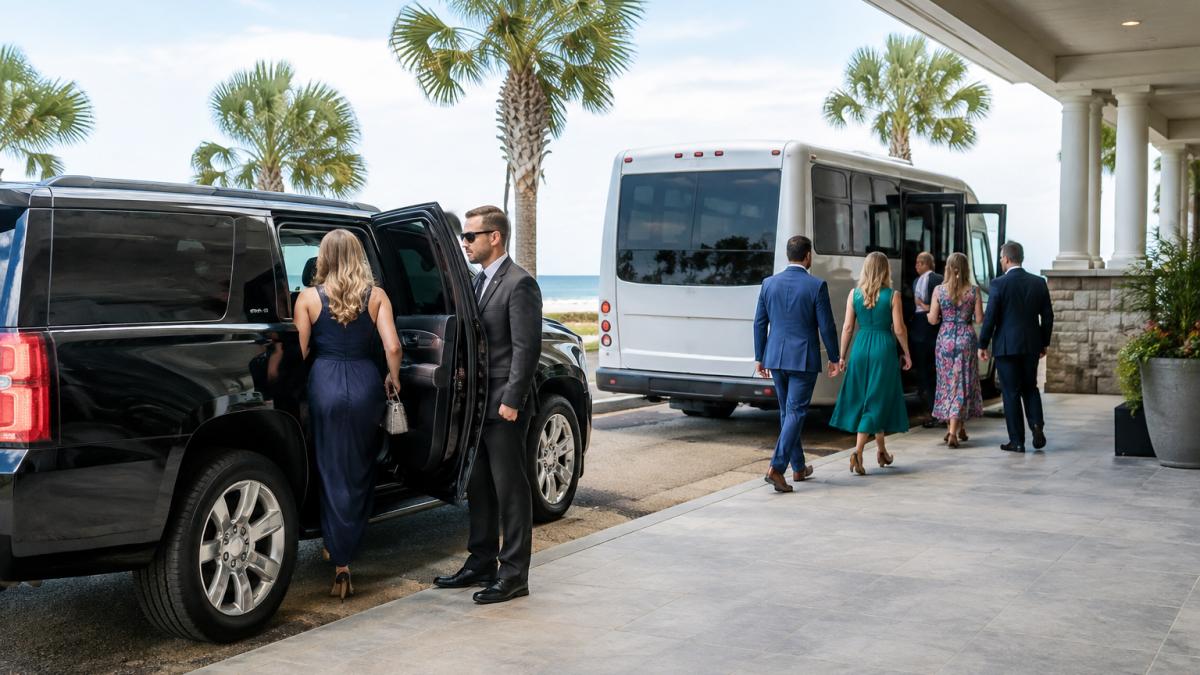
Wedding guest transportation planning means moving guests between hotels, the ceremony, and the reception on a schedule that survives real traffic. Build around three fixed points: pickup, ceremony arrival, and the final return trip.
Pickup Points, Drop-Off Locations, and Route Sequencing
One central pickup point beats three scattered ones. A single hotel lobby keeps loading fast and prevents drivers from idling at multiple stops.
Sequence the route like this:
- Pickup: main hotel, loaded 15 minutes before departure
- Second stop: overflow hotel, only if needed
- Drop-off: ceremony venue, arrival 20-30 minutes early
Check venue transportation details before locking the route. Parking availability and venue location shape where a bus can actually stop.
Use a Wedding Transportation Schedule Template
A schedule template turns the plan into something a driver and a guest can both follow. Fill it in once, share it twice: with the provider and with guests.
| Time | Stop | Action | Riders |
|---|---|---|---|
| 2:45 PM | Hotel A lobby | Load guests | 28 |
| 3:00 PM | Depart Hotel A | En route | 28 |
| 3:25 PM | Ceremony venue | Drop-off | 28 |
| 4:45 PM | Ceremony venue | Load for reception | 30 |
| 9:00 PM | Reception venue | First return trip | 22 |
| 10:30 PM | Reception venue | Final return trip | 14 |
Share the guest-facing version with pickup times only. Drivers get the full version with addresses and contact numbers. For a deeper walkthrough of group travel logistics, see our group travel coordination guide.
Budgeting for Guest Transportation Without Guessing
Guest transportation is often quoted per vehicle and per hour rather than per person, so the same route can cost different amounts depending on how a quote is structured. A transparent budget starts with quote mechanics, not a lump sum.
The Five Variables That Drive Every Quote
Ask any provider to break a quote into these five lines so you can compare apples to apples:
- Base hourly rate: charged from vehicle report until release, often with a minimum block. Ask providers for their own minimums.
- Minimum hours: the floor you pay even if the event runs short. A four-hour minimum on a three-hour event still bills four hours.
- Deadhead and positioning: time and distance to bring the vehicle to your first pickup and return it after the last drop-off. Some providers fold this into the hourly rate; others bill it separately.
Planners often compare only the hourly rate, then discover minimum hours, gratuity, and surcharges push the final invoice well above the quote. Build your comparison sheet around total estimated cost, not rate.
A Simple Cost-Planning Worksheet
Use this structure to turn quotes into a comparable budget. Fill one column per provider.
| Line item | What to enter | Why it matters |
|---|---|---|
| Vehicles and capacity | Number and type of vehicles quoted | Determines whether the quote actually fits your rider count |
| Billable hours | Hours quoted vs. minimum hours | The larger of the two is what you pay |
| Base rate x billable hours | Rate times billable hours | The core cost |
| Deadhead/positioning | Any separate charge | Often the hidden difference between quotes |
| Gratuity | Percentage or flat amount | Confirm mandatory vs. discretionary |
| Fees and surcharges | Fuel, tolls, parking, holiday | Small lines that add up |
| Overtime rate | Per-hour charge beyond the booked window | Your exposure if the event runs late |
| Deposit and cancellation terms | Amount and deadline | Cash-flow and risk |
| Estimated total | Sum of the above | The only number worth comparing |
Sample Budget Scenarios
Pricing depends on quantity, dates, and delivery details, so treat the structure below as a template and plug in your own quotes. For current prices or a quote, visit the Icon Transportation Wilmington website.
- Single-hotel loop, one minibus: one vehicle, a short minimum block, one round trip. Lowest total, but only works if all riders stay at one hotel.
- Two-hotel loop, two sprinter vans: two vehicles running staggered departures. Higher vehicle count but smaller per-vehicle rate, and better rider experience than one crowded bus.
- One motor coach, multiple trips: one large vehicle making two or three runs. Cheapest per rider when the coach runs full; expensive per rider if it runs half empty.
Watch out: a quote that looks cheapest on the hourly rate can be the most expensive total once minimum hours, gratuity, and surcharges are added. Always compare estimated totals.
Vetting a Provider: Contract and Insurance Checklist
Before signing, confirm these items in writing:
- Current commercial insurance with coverage limits stated, and a certificate of insurance provided directly
- Licensed drivers and current vehicle inspection records
- Cancellation and change policy in writing, including deadlines and penalties
Ask any provider for proof of insurance before booking. For a deeper walkthrough of group travel logistics, see our group travel coordination guide.
Plan for Delays, Accessibility, and Day-Of Contingencies
A transportation plan is only as good as its worst fifteen minutes. Traffic, weather, a late ceremony, or a guest who needs more time can cascade through every trip after it. Build around named responsibilities and explicit buffers rather than hoping the day runs perfectly.
A Day-Of Disruption Playbook
Assign one person, a planner, a point of contact, or a trusted family member, to own transportation communication. That person holds the provider's day-of number and the guest-facing schedule, and makes the call when something slips.
Work through these scenarios before the event:
- Traffic delay on the first leg: call the venue and the officiant, not just the driver. A ten-minute delay at pickup can be absorbed if the ceremony start is flexible; if it is not, the point of contact decides whether to hold the ceremony or start without the delayed group.
- Late-running ceremony or reception: the driver waits, but waiting time bills. Decide in advance whether the point of contact can authorize overtime, and up to what amount, so no one is negotiating money in the moment.
- Vehicle breakdown: confirm the provider's backup vehicle plan in writing and the expected response time. Keep the point of contact's number on the guest-facing schedule so riders can report a problem directly.
Watch out: a schedule with zero buffer collapses after one late guest. Add 15 minutes to each arrival window and treat the buffer as part of the plan, not slack to be spent.
Accessibility and Inclusive Transportation
Accessibility is the most commonly overlooked part of guest transportation, and easiest to solve at booking rather than on the day.
- Wheelchair and mobility access: ask the provider directly whether any vehicle in the fleet is wheelchair-accessible, and confirm the ramp or lift capacity and the number of securement positions. Not every vehicle is accessible, so confirm this with the provider.
- Older guests and limited walking distance: choose drop-off points as close to the entrance as the venue allows, and confirm with the venue where a vehicle can legally stop. A shorter walk matters more than a shorter drive.
- Child seats: if children will ride, confirm whether the provider supplies child seats or whether parents must bring and install their own. Rules and provider policies vary, so settle this in writing.
A common pattern is for planners to ask about accessibility only after a guest raises it. Ask at booking, and put the answer in the contract.
The Day-Of Transportation Brief
Give the driver and the point of contact the same one-page brief: pickup times and addresses, rider counts per stop, the day-of contact number, the overtime authorization limit, and any accessibility notes. Share a guest-facing version with pickup times only. For a deeper walkthrough of group travel logistics, see our group travel coordination guide.
Request a Quote and Lock Your Guest Transportation Dates
Dates fill fast in wedding season, so request quotes as soon as your ridership estimate is solid. Bring three numbers: estimated riders, pickup locations, and your event timeline.
Icon Transportation Wilmington handles group travel for up to 54 guests with a fleet that includes full-size SUVs and 14-passenger party buses.
Get started with Icon Transportation Wilmington and request a quote before the calendar fills.
Frequently Asked Questions
How do I ask wedding guests if they need transportation?
Add a transportation question to your RSVP form. Ask for hotel name and arrival date so you can group riders by pickup point. Follow up two to three weeks before the event with a short email confirming departure times and pickup locations. Give guests a firm RSVP deadline for the shuttle, since your vehicle count depends on final numbers. A simple checkbox beats an open-ended request every time.
How far in advance should I book guest transportation?
Book four to six months ahead for weddings and large events, and earlier if your date falls in a busy season. Peak Saturdays and holiday weekends fill fleets first, and multiple shuttles for a large guest list are harder to source than a single vehicle. Corporate travel and airport transfers can usually be arranged with a few weeks' notice, but recurring accounts are worth setting up in advance so scheduling stays consistent.
How many guests can a charter bus or minibus accommodate?
Capacity depends on vehicle type. Party buses in the Icon Transportation Wilmington fleet seat 14 passengers. Divide your estimated ridership by vehicle capacity to estimate your vehicle count, and confirm capacity details with the provider. Fleets that top out around 54 guests per booking may need multiple vehicles for larger groups.
Is professional guest transportation worth the cost compared to rideshares?
Compare what each option actually includes. Rideshares shift coordination to guests, who may face surge pricing and long waits when an event lets out. Professional transportation bundles a fixed schedule, a vetted driver, insurance, and one pickup point everyone can find. For groups moving between hotels and venues on a timeline, that reliability is the product. Request itemized quotes so you can compare per-rider costs rather than headline prices.
The hardest part of guest transportation is not picking a vehicle. It is committing to a rider count and a schedule early enough to book. Do that first, and the rest of the planning falls into place.
Icon Transportation Wilmington can take the logistics from there. Our customized scheduling, chauffeured fleet, and capacity for up to 54 guests mean your group arrives together and on time. Request a quote and get your dates on the calendar.