 how-to
Hire a Chauffeured Bus for Wedding Guests: 2026 Guide
Table of Contents
- Why Hire a Chauffeured Bus for Wedding Guests
- Vehicle Options: Charter Bus, Minibus, and Sprinter Van
- Wedding Bus Capacity: Matching the Vehicle to Your Guest Count
- What Wedding Transportation Cost Really Includes
- Building a Wedding Transportation Schedule That Works
- Wedding Shuttle Route Planning: Pickups, Venue Transfers, and Late-Night Returns
- How to Hire a Chauffeured Bus: Booking Timeline and Contract Checklist
- Frequently Asked Questions
Last Updated: October 18, 2026
Why Hire a Chauffeured Bus for Wedding Guests
A chauffeured bus is a hired vehicle with a professional driver who transports wedding guests between hotels, ceremony sites, and reception venues on a set schedule.
The case for booking one is stronger than most couples expect.
There's a safety argument too. The National Highway Traffic Safety Administration reports that alcohol-impaired crashes spike on weekend nights, which is exactly when most receptions end.
Below, we'll walk through vehicle options, capacity math, costs, and the booking timeline, so you can hire a chauffeured bus with confidence instead of guesswork.
Vehicle Options: Charter Bus, Minibus, and Sprinter Van
The right vehicle comes down to three numbers: your guest count, your route, and how many separate pickups you need.
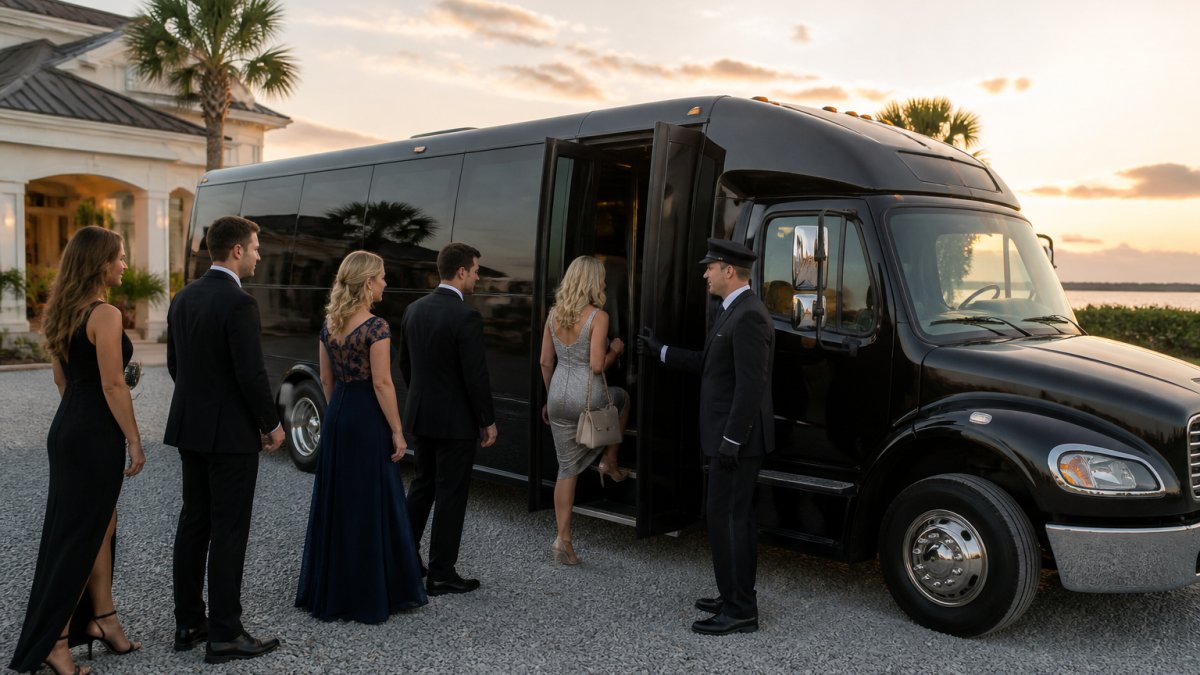
Minibus. A minibus sits in the middle: more capacity than a van, more maneuverability than a charter bus.
Sprinter van or passenger van. These suit intimate groups, bridal party transfers, and shuttle runs where flexibility matters more than headcount.
A party bus is a different animal. It's built for the celebration itself, with limo-style seating, sound systems, and TVs.
Wedding Bus Capacity: Matching the Vehicle to Your Guest Count
Wedding bus capacity planning starts with a realistic guest count, not your invitation list. Expect a portion of invitees to decline, and plan shuttle seats around confirmed attendees plus a small cushion.
Here's how we think about matching vehicles to groups:
| Group Size | Best Vehicle Fit | Typical Use |
|---|---|---|
| Up to 14 guests | Sprinter van or party bus | Bridal party, intimate weddings |
| 15-30 guests | Minibus | Single hotel block, one loop |
| 30-54 guests | Charter bus or multiple minibuses | Full guest shuttle, multiple hotels |
| 55+ guests | Multiple vehicles on staggered loops | Large weddings, multi-hotel pickups |
If your hotel block holds 60 guests, one bus making two runs can work, but the timing has to be tight.
What Wedding Transportation Cost Really Includes
Wedding transportation cost is built from a handful of billable inputs, and understanding each one is the difference between comparing quotes fairly and comparing apples to oranges.
Billable inputs to ask about:
- Hourly rate with a minimum. Charters are typically billed by the hour with a minimum block (commonly four to six hours for a wedding). A three-hour event can still carry a five-hour minimum, so ask what the minimum is before you fall in love with a rate.
- Deadhead and positioning time. The clock often starts when the vehicle leaves the depot, not when it reaches your hotel. Ask whether travel to the first pickup and back from the last drop-off is billed.
- Mileage or distance bands. Some quotes include a mileage allowance inside the service area and charge per mile beyond it. Multi-hotel routes and venue-to-venue transfers can push you past that allowance.
- Wait time. The bus idling during your ceremony and cocktail hour is usually billable. A two-hour ceremony plus a one-hour cocktail hour is three hours of paid standby unless your contract says otherwise.
- Overtime. If the reception runs long, overtime is typically billed in increments (often 30 or 60 minutes) at a higher rate than the base hourly. Confirm the increment and the rate in writing.
- Additional stops and extra trips. A late-night second return run or an unscheduled hotel drop is usually a change order. Ask how those are priced before the day, not after.
Sample budget scenarios (illustrative, not quotes):
- Single-loop shuttle, one hotel to one venue, four-hour block. The dominant cost is the hourly minimum plus wait time during the ceremony. A short route with one pickup point is the most predictable scenario to budget.
- Two-hotel pickup with ceremony-to-reception transfer, six-hour block. You are paying for two pickup stops, a transfer leg, and standby time at both the ceremony and reception. Expect the hourly block and any mileage overage to drive the total.
- Late-night return runs added to a reception shuttle. Each additional scheduled run after the reception typically triggers overtime or a per-trip charge. Budget for the number of return waves you actually need, not just one.
How to compare quotes line by line:
- Normalize every quote to the same hours, same route, and same number of stops.
- Ask each provider to state the overtime rate, the wait-time policy, and the cancellation terms in writing.
- Confirm whether gratuity and fees are included in the total or added at settlement.
- Get the all-in estimate in writing before you sign, and keep it with the contract.
We don't publish flat rates because a two-hotel loop with a late-night return prices nothing like a single-hotel shuttle. Request a free quote with those specifics and compare the line items above side by side.
Building a Wedding Transportation Schedule That Works
A wedding transportation schedule is a written timeline that assigns every vehicle, pickup location, and drop-off time for the day. Build it backward from your ceremony start time, then add buffer at every transition.
Start with these fixed points:
- Guest hotel pickup - allow 30-45 minutes before the ceremony
- Ceremony arrival - guests seated 15 minutes early
- Ceremony-to-reception transfer - one coordinated move
- Reception end and late-night return - staggered departures
Share the schedule with your venue, your hotel block, and every guest. A printed card in the welcome bag or a text the morning of prevents the "when is the bus leaving?" scramble.
Wedding Shuttle Route Planning: Pickups, Venue Transfers, and Late-Night Returns
Wedding shuttle route planning means mapping the shortest sensible loop between hotels, ceremony, and reception, then repeating it on a fixed timetable with buffer built in.
Build the route in this order:
- Anchor on the ceremony start time. Work backward: guests should be seated 15 minutes early, so the last pickup must land at the venue with that cushion.
- Choose one primary pickup point. A single hotel block is the most reliable. Add a second stop only if it is genuinely on the way.
- Plan pickup waves, not one mass boarding. For larger groups, two waves (for example, an early wave for family and elderly guests, a later wave for everyone else) reduce crowding at the curb.
- Map the ceremony-to-reception transfer as its own leg. This is the most time-sensitive move of the day. Confirm load-in and load-out points at both venues in advance.
- Schedule late-night returns in waves. Guests leave at different times. Two or three scheduled return runs (for example, an early run for older guests and families, a mid run, and a final run at close) keep everyone off the road.
Buffer times that hold up in practice:
- 30-45 minutes from hotel pickup to ceremony arrival, depending on distance and traffic.
- 15 minutes of slack at every transition, hotel to bus, bus to venue, ceremony to reception.
- 10-15 minutes of staging time at each venue for the vehicle to position and load.
Venue access and staging:
Confirm with each venue where a charter bus or minibus can stage, load, and turn around.
Contingency planning for the day:
- Traffic and delays. Build the buffer into the schedule, not into the driver's speed.
- Late ceremony or reception. Have a pre-agreed trigger: if the ceremony starts more than 15 minutes late, the first return wave shifts by the same amount. Tell guests the plan in advance so they aren't waiting at the curb.
- Vehicle failure. Ask your provider what backup vehicle they can dispatch and how quickly. A written backup plan is part of a professional contract.
- Weather. Have an indoor or covered loading point identified at each venue so guests aren't standing in rain or heat while the bus positions.
- Guest overflow. Keep the provider's day-of contact number handy so a last-minute extra passenger or an unplanned stop can be handled with a phone call rather than a scramble.
Share the schedule with everyone who touches it: the venue, the hotel block, and every guest.
Federal Motor Carrier Safety Administration regulates commercial passenger carriers, so confirm any provider operates legally and carries proper insurance before you book.
How to Hire a Chauffeured Bus: Booking Timeline and Contract Checklist
Booking a chauffeured bus works best on a timeline that starts months ahead. Here's the sequence we recommend:
- 6-9 months out: Estimate guest count and shuttle demand; identify hotel blocks
- 4-6 months out: Request quotes from providers; compare vehicle options
- 2-3 months out: Confirm booking and sign the contract; lock in the schedule
- 2-4 weeks out: Share final guest counts and route details; confirm pickup times
- Week of: Send the schedule to guests and venue; confirm driver details
Before you sign, run through this checklist:
- Licensed and insured carrier with proof of coverage
- Written contract stating hours, overtime rate, and cancellation terms
- Confirmed vehicle capacity and backup plan if a vehicle fails
- Named pickup and drop-off locations with staging instructions
- Late-night return schedule in writing
- Clear policy on additional stops and last-minute changes
- Contact number for day-of coordination
At Icon Transportation Wilmington, our fleet handles groups up to 54 guests, and our chauffeured service runs any hour your schedule requires. We build customized itineraries for weddings and events, and we confirm every detail in writing before the day arrives.
Frequently Asked Questions
How do I hire a chauffeured bus for wedding guests?
Start by estimating your guest count and how many will need rides, then choose a vehicle size that fits. Contact a licensed and insured provider with your date, venue, hotel pickup locations, and a rough timeline. Request a written quote, confirm what the rate covers, and review the contract for overtime and cancellation terms. Book four to six months ahead for peak wedding season, and share a final passenger list and schedule with the company one to two weeks before the event.
How much does wedding guest transportation cost?
Wedding transportation cost depends on the vehicle type, number of hours reserved, distance between hotels and the venue, and how many trips you need. Rates typically combine an hourly charge with fuel and driver time, and some companies quote all-inclusive rates. Because pricing varies by date and itinerary, request a free quote with your specific schedule rather than relying on a general estimate. Ask whether gratuity, tolls, and overtime are included so the final bill matches the quote.
How many guests can a wedding shuttle bus hold?
Capacity depends on the vehicle. Sprinter vans and passenger vans usually carry around 14 passengers, minibuses handle roughly 20 to 30, and full charter buses can seat up to about 54 guests. For a wedding bus capacity plan, assume guests will not all ride the same trip: many will drive or stay at the venue. A common approach is to size the bus for 60 to 70 percent of out-of-town guests and add a second vehicle or extra trips if hotel pickups are spread across several locations.
When should I book wedding transportation?
Book four to six months before the wedding for peak season dates, and earlier if your wedding falls on a holiday weekend or you need multiple vehicles. Finalize the wedding transportation schedule about one month out, once your guest count and hotel block are set. Give the provider your final pickup times and passenger counts one to two weeks before the event so drivers can confirm routes. Last-minute bookings are sometimes possible but limit vehicle options and pricing flexibility.
Planning wedding transportation means juggling guest counts, hotel blocks, and a schedule that can't slip. That's the part we take off your plate. Icon Transportation Wilmington offers a licensed and insured chauffeured fleet with capacity for up to 54 guests, customized scheduling for weddings and private celebrations, and professional drivers available any hour. Get started with Icon Transportation Wilmington and give your guests a ride they'll actually remember.